

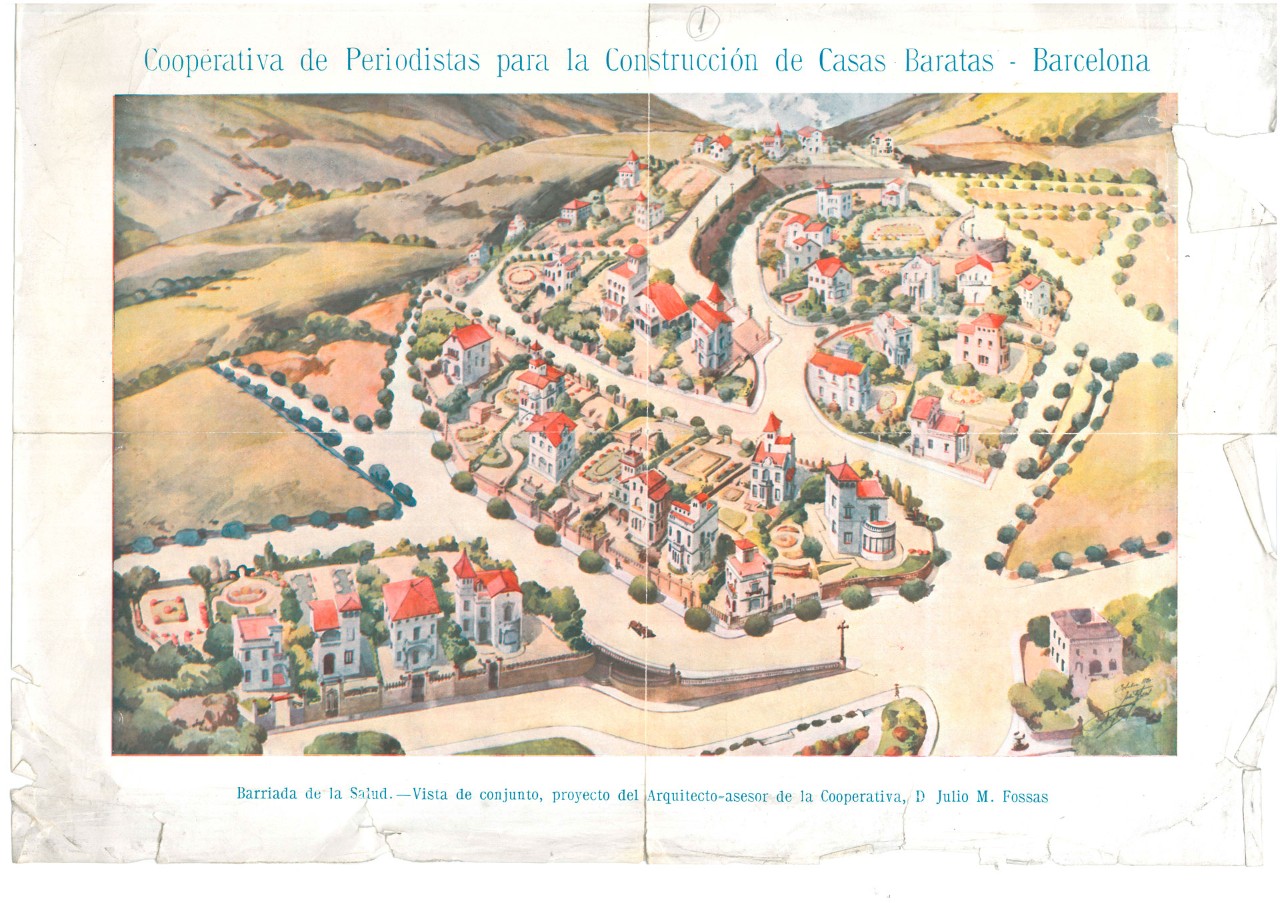
Health District. Overview, project of the Cooperative Architect-Advisor, D. July M. Fosas. Cooperative of Journalists for the Construction of Cheap Houses. Barcelona, s/f. [ACMITES. Institute of Social Reforms, “Casas Baratas”, 1921-1933”]
“Thus studied the problem, it would be seen that not only are many houses lacking to be built in all countries, but many of the houses that currently exist in our very defective cities, must disappear so that all, and mainly the wealth-producing classes are better housed; so that industries, so that the land is better used, fulfilling the great social mission entrusted to it, not being, as is the present, the object of scandalous speculation for the benefit of the few and to the detriment of the most; in short, so that humanity may live more reasonable; healthier, quieter and happier.”
The report “The problem of housing and cheap houses”, coordinated by the Section of Cheap and Economic Houses of the Ministry of Labour, Trade and Industry, concluded through this pertinent plea. Eduardo Aunós as Under-Secretary of the Department. On the occasion of International Archives Week (#IAW2024) and based on one of the objectives set by the International Council of Archives (“to raise awareness among the general public and the public and private sectors of the need to preserve and facilitate access to archives in the long term”), the Central Archive published this unpublished historical document of 1925. Almost a century ago!
Health District. Overview, project of the Cooperative Architect-Advisor, D. July M. Fosas. Cooperative of Journalists for the Construction of Cheap Houses. Barcelona, s/f. [ACMITES. Institute of Social Reforms, “Casas Baratas”, 1921-1933”]
The documentary funds of the Service of Cheap and Economic Houses preserved in the Central Archive of the Ministry of Labour and Social Economythey make it possible to draw an X-ray of the role played by this Department and its successive bodies in urban planning aimed at access to decent and affordable housing. The Service of Cheap and Economic Houses was born in 1922, depending on the General Directorate of Labor. From 1931, its competences were integrated into the Social Action Service, as well as the Real Estate Social Policy Board. In 1938 it was extinguished by being replaced by the National Administration Board of Cheap Houses, for the following year with the creation of the National Housing Institute that agency assumed all the functions and competences regarding the “Previous Regime of Cheap and Economic Houses and Social Real Estate Policy”.
Going back to 1925, but with a view to our historical present, it does not cease to amaze the notorious similarities between the current situation of the housing market and what happened, main, although not only in Madrid, almost a century ago. The report does not limit itself to describing its present but looks back in search of the root of the aforementioned problems; focusing on such decisive issues as the role of the State and the construction societies, emigration, the coal crisis or the so-called excess of day labourers, the relevant factor of the value of the land and the precarious transport network, the correlation between the workers’ strikes and the pace of construction, the worrying price of rents with clear moralistic resonances (“and of [the] very small dimensions [of the rooms], which oblige the promiscuity of the sexes and the precept of cleaning up the houses. The language, the conception of society, as well as the vision of human interrelations are typical of its historical time: the military dictatorship of Primo de Rivera between the end of the Military Directory and the beginning of the Civil Directory.
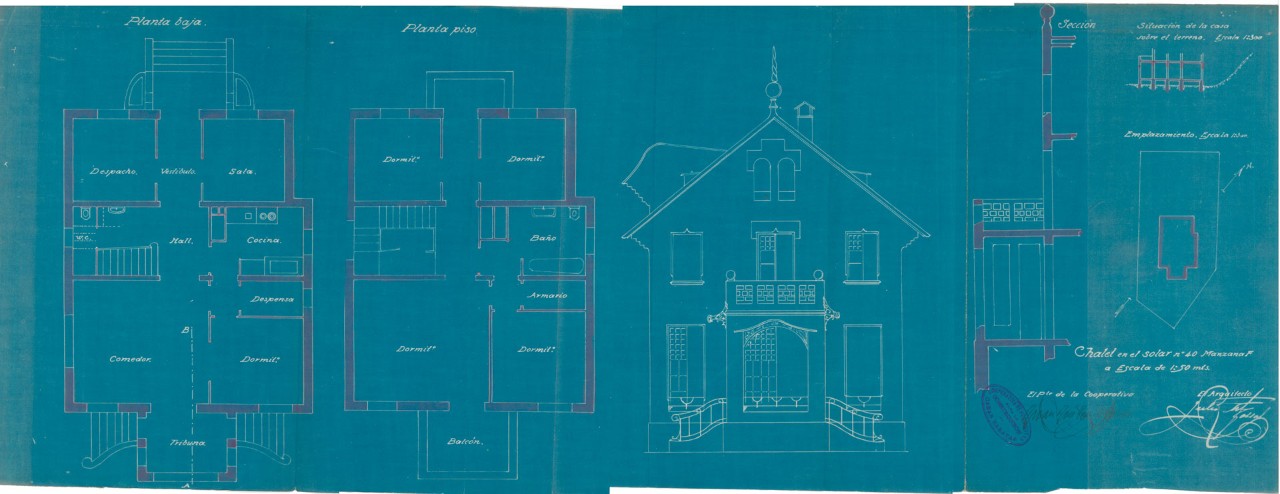
Plan of the chalet of the Cooperative of Journalists for the Construction of “Cheap Houses” in the plot No. 40, block F. Barcelona, 1919 [ACMITES. Institute of Social Reforms, “Casas Baratas”, 1921-1933”]
As the aforementioned report explains, the Casas Baratas were started thanks to the “Law on Construction of Cheap Houses” (Gaceta de Madrid, no. 164, of 13/06/1911) and based on the "proposal and management of the benemeritus "Institute of Social Reforms"". From there, its application in Vizcaya is reviewed as a model of success or in Granada later, comparing it with similar initiatives such as “The Garden City” of Belgium, and with citation included to events as important as the VI International Building Congress.
The second part of the report provides valuable statistical and macroeconomic data on the “number of beneficiaries in Madrid and its province” according to the Casas Baratas regulations. All this through a tour of the different cooperatives and initiatives that travel all over Madrid and its periphery in the first third of the 20th century, with interesting details and information of each project and a complete list of its beneficiaries that allows us, in parallel, to know the neighbors of that capital that had and has in access to housing one of its main problems.
Under the cover of #IAW2024, the Central Archive of the Ministry of Labour and Social Economy aims with this initiative to sensitize public opinion on the importance of documents and archives and, specifically, on the extraordinary wealth of our Documentary Heritage.