

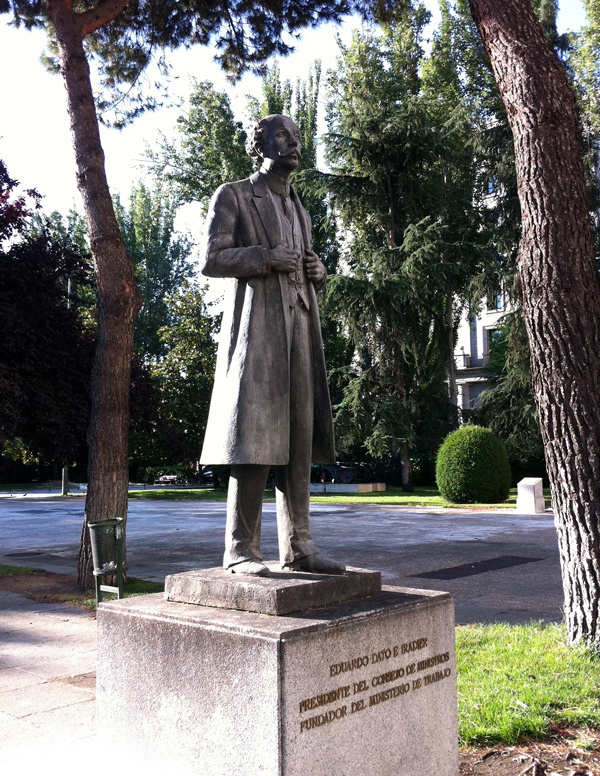
Statue of Eduardo Dato Iradier. Ministry of Labour and Social Economy (image Publications Service)
Statue of Eduardo Dato Iradier. Ministry of Labour and Social Economy (image Publications Service)
The Central Archive of the Ministry of Labor and Social Economy (MITES) wanted to celebrate the International Day of Archives of 2021 with this guide of documentary sources dedicated to who was the founder of the Ministry of Labor in May 1920, Eduardo Dato Iradier, in the centenary of his death: a compilation of primary, secondary and legislative sources that we hope will help to know and rebuild the intense journey of the Spanish politician, prematurely concluded with his murder in an attack on the afternoon of Tuesday, March 8, 1921.
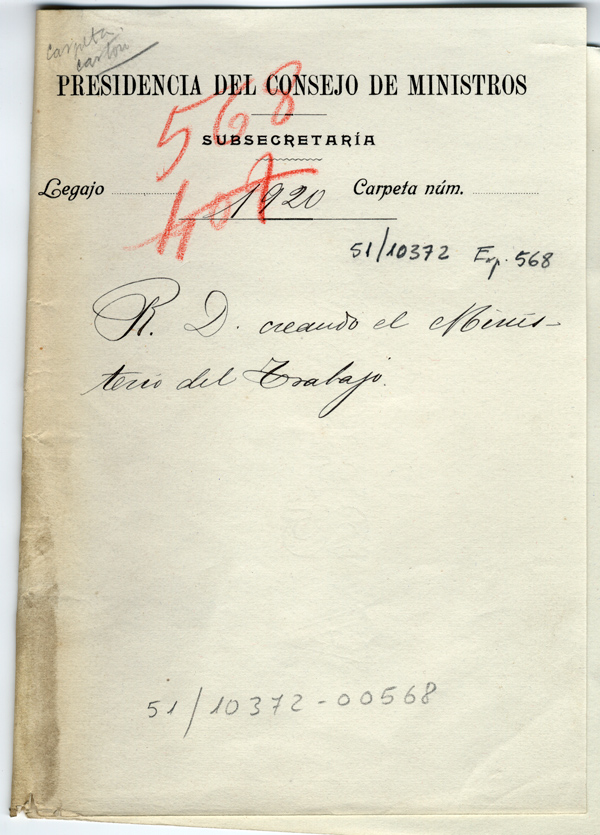
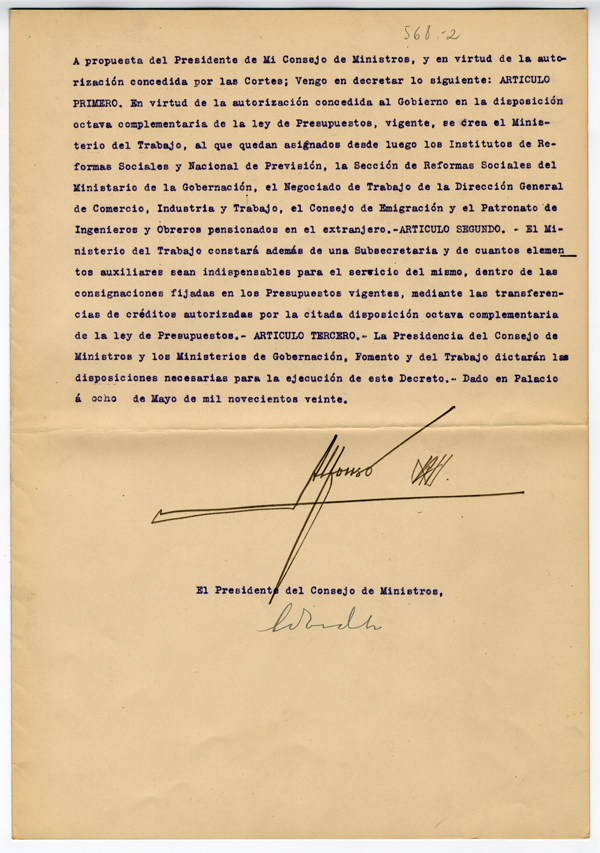
Citing Professor Santiago Castillo in the first chapter of the collective book commemorating the centenary of the MITES (“Background, creation, first steps of the Ministry of Labour in Spain, 1920-1923” in Santiago Castillo (dir. ), One Hundred Years of the Ministry of Labour in Spain, Madrid, Ministry of Labour and Social Economy, 2020, pp. 17-56), the personal commitment of Eduardo Dato Iradier in the project of creation of the Ministry of Labor since at least 1914 should be highlighted. A project that was postponed for a few years as a result of the First World War, although it was relaunched at its end. In this sense, the Treaty of Versailles contributed to its creation. Paragraph XIII of the Treaty of Versailles gave “origin to the constitution of the International Labour Organization [ILO], which reflected the conviction that in order to achieve universal and permanent peace, social justice was essential, which implied the need for cooperation in order to obtain equality in working conditions in countries competing for markets.” We find ourselves, in this way, in the so-called crisis of the system of the shift (1914-1922) marked by major workers’ conflicts and in which the nascent liberal State began to offer answers to the “social question”. In this historical context, “Dato took advantage of his first return to the Presidency of the Council to immediately order the creation of the new Ministry; the constitution of his government was of May 5, 1920, the Decree of creation of the Ministry of Labor was dated 8”.
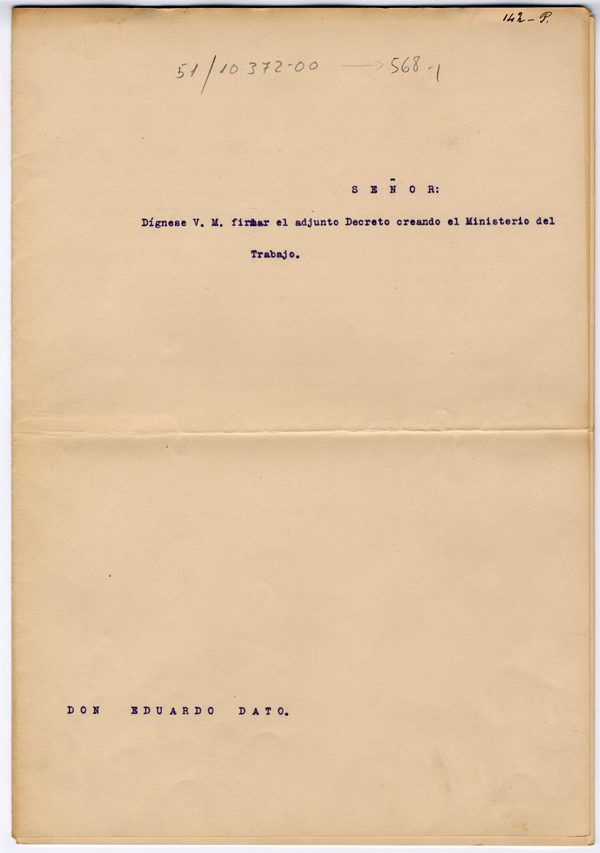
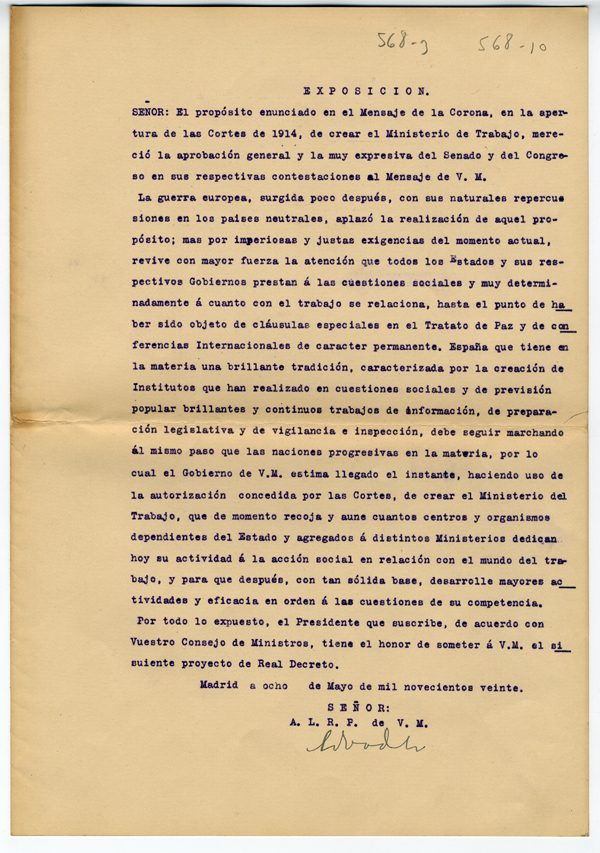
In the Exhibition del Royal Decree creating the Ministry of Labour (Gaceta de Madrid: no. 130, from 09/05/1920) we recall, first of all, the antecedents, previously described, to then affirm: “Spain, which has a brilliant tradition in the field, characterized by the creation of institutes that have carried out brilliant and continuous information, legislative preparation and monitoring and inspection work on social issues, must continue to march at the same pace as progressive nations in the field.” And without further delay, the “Ministry of Labour was created, which for the time being gathers and brings together all the Centres and agencies dependent on the State and attached to different Ministries that today devote their activity to social action in relation to the world of work”. Then, it was pointed out what is perhaps the most relevant point of the aforementioned Royal Decree: “so that later, with such a solid foundation, it develops greater activities and effectiveness in order to deal with the issues of its competence.” That same Thursday, May 9, the deputy to Cortes Carlos Cañal and Migolla He was appointed Prime Minister of Labour (1920-1921). The interest and will of Eduardo Dato Iradier himself in this project gives a good account as the 30th of May of that same year was published in the Gaceta de Madrid (no. 151, from 30/05/1920) the Royal Decree providing that the organization and services dependent on this Ministry conform to the plant that is published, and approving the provisional Regulations of administrative procedure and internal regime of this Department. A great legislative effort for which, in addition, a large budgetary amount was allocated.
The Font Guide has been structured as follows: