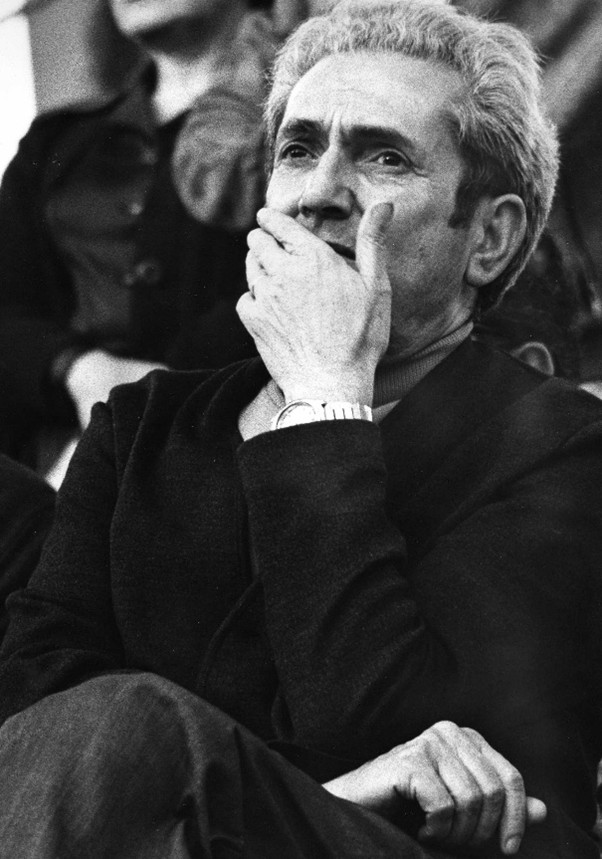
Marcelino Camacho 1978. At the first party of the PCE in the Casa de Campo, after its legalization [Source: Wikipedia]
Marcelino Camacho 1978. At the first party of the PCE in the Casa de Campo, after its legalization [Source: Wikipedia]
Public archives have always been, are and will always be a basic tool for the effective exercise of the Right to Truth and guarantees of non-repetition, as highlighted in the article. Law 20/2022, of 19 October, on Democratic Memory. On this path, and in commemoration of May 1st, 2025, International Workers’ Day, from the Central Archive of the Ministry of Labour and Social Economy we publish the file of Marcelino Camacho in his application for the well-known “Labour Amnesty”
Who doesn’t remember a Camacho defending the Amnesty from the gallery of speakers of the Congress of Deputies? Without a doubt, this is one of the iconic images of the 20th century in Spain.
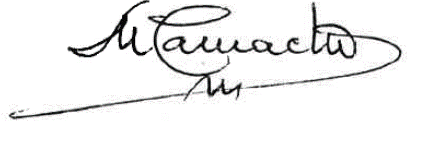
The Central Archive of the Ministry of Labor guards the documentary series “Amnesty Labour files in application of Law 46/1977, of 15 October”. The Amnesty Act was one of the first public policies of remembrance in terms of economic reparation (articles 5 and 8). It was not easy or easy to pass regulations; in fact, until 1985 its legal regime was not clarified, not forgetting that many of its applicants would be charged the IRPF as if during the time in prison they had been working. A legal battle that would last until 2006.
In fact, the demand to enforce the right to the benefits established in the “Labor Amnesty” by the leaders of the class workers’ movement, but also by tens of hundreds of anonymous workers, gave way to another of so many struggles of the trade union movement. A legal battle in which labour lawyers played a central role – another group that helped reconstruct the democratic logic under the Franco dictatorship. His claims and actions appeared repeatedly in the media until reaching the Ombudsman himself.
This double story, that of the workers’ struggle under Franco’s rule – as the main socio-political actor in the transition to democracy – and the battle to make the right to economic reparation effective through Labor Amnesty, can be traced through this Documentary Fund that tells us so much about our recent past.
Why Marcelino? Among the thousands of dossiers, no other name generates such a capacity for consensus as that of Marcelino Camacho Abad (1918-2010). Fresador, co-founder of the current Trade Union Confederation of the Workers’ Commissions, member of the Congress of Deputies for the Communist Party of Spain. A man of integrity respected by his companions, comrades, friends or enemies. Always accompanied by Josefina, weaving intra- and extra-wall solidarity networks from the Carabanchel Prison.
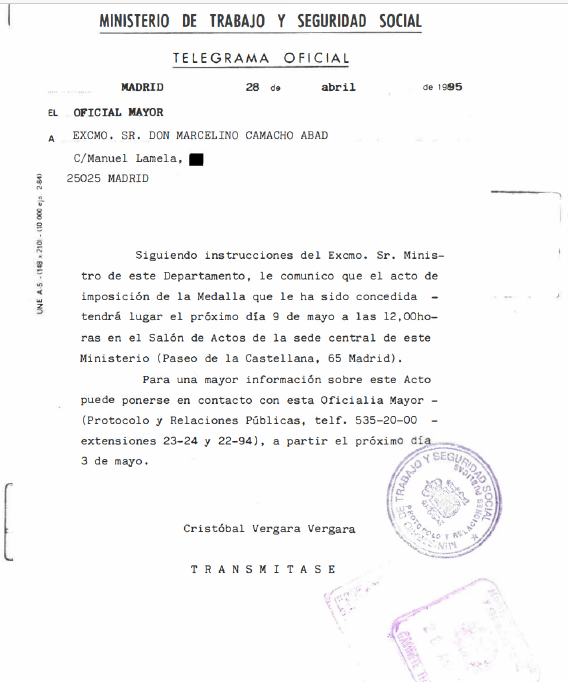
This is not the first time that the Labor Department has recognized the figure of Camacho Abad. In 1995 he was awarded the highest distinction of the then Ministry of Labor and Social Security: the Merit of Labor medal in its Gold Category, along with his peers of “Process 1001”. One of the happiest moments of his life as he acknowledged on numerous occasions. Camacho himself would include the sentence handed down by the Court of Public Order (TOP) in his request to be granted the “Labor Amnesty”.
Approaching this dossier is to go through not only a personal biography, but also a collective biography of what was the history of the workers’ movement in its generality and in particular in the south of Madrid: Motor Ibérica, Carabanchel… Barrio madrileño where was the great prison of the Franco regime (where I spend long periods of imprisonment) and a few kilometers away from his humble home.
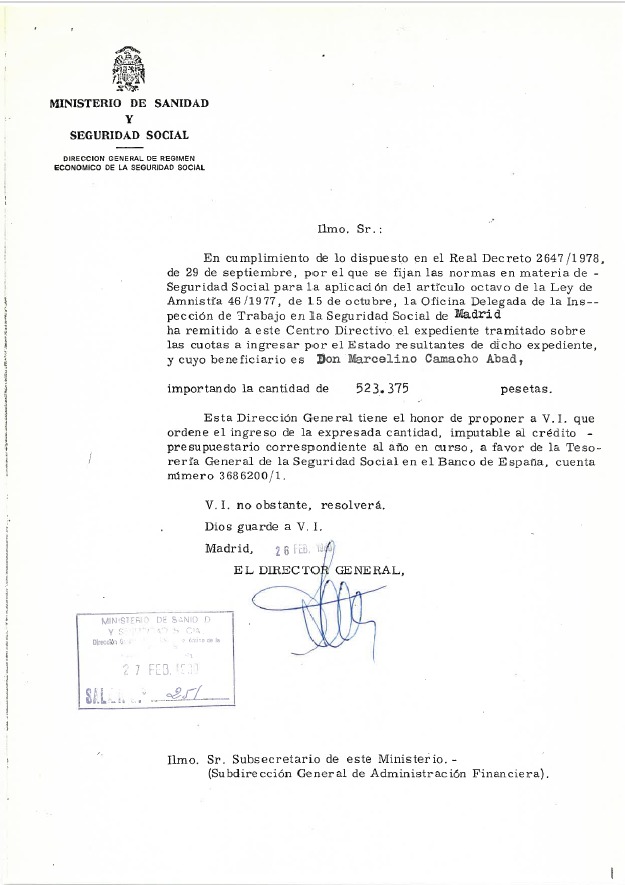
On February 26, 1980, the Ministry of Health and Social Security recognized the payment of 523,375 pesetas, an amount with which he could almost finish paying for that house on Manuel Lamela Street. A few meters away was General Ricardos Street, where every May 1st he took bus 34 to go to the demonstration to celebrate the workers’ party with an enthusiasm and enthusiasm that lasted until his health problems prevented him from doing so.